
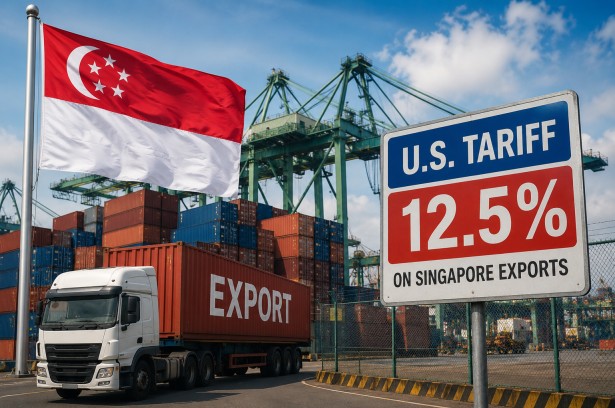
The United States has announced a new 12.5% tariff on approximately one-third of Singapore’s domestic exports, citing issues related to forced labor enforcement. This move is part of a wider trade strategy affecting numerous global economies. In response, Singapore has firmly rejected the U.S. claims, highlighting its robust legal framework designed to combat forced labor and its zero-tolerance policy towards such practices. The Ministry of Trade and Industry in Singapore has expressed its intention to continue discussions with U.S. trade officials to gain a better understanding of how the new tariff will be enforced.
While the new tariff applies to a significant portion of Singapore’s exports, several crucial sectors have been spared. Notably, pharmaceuticals, semiconductors, certain electronics, aerospace products, and energy products remain unaffected by this measure. Additionally, goods already subject to sector-specific U.S. tariffs are exempt, providing some relief to exporters in these industries.
Business communities have voiced concerns that the tariff could lead to increased uncertainty for manufacturers and exporters. This uncertainty is compounded by an ongoing U.S. investigation that could potentially result in further trade restrictions. In light of these developments, industry leaders are advising companies to explore new export markets and enhance the resilience of their supply chains to mitigate potential disruptions.
The imposition of this tariff is seen as part of a broader U.S. trade policy aimed at addressing labor concerns globally. However, Singapore’s government remains committed to defending its trade practices and ensuring that its export sectors are not unjustly penalized. The dialogue between the two nations continues, as officials work towards finding a resolution that addresses U.S. concerns while preserving Singapore’s economic interests.