
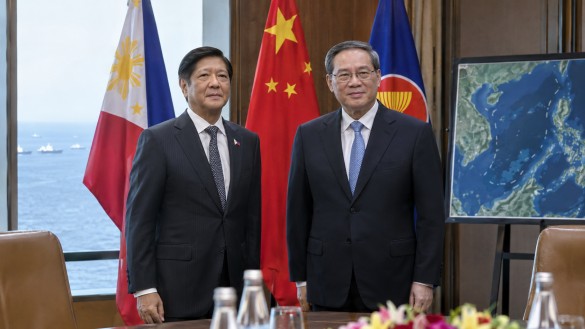
Amid ongoing tensions in the South China Sea, the Philippines and China have committed to strengthening ties with the Association of Southeast Asian Nations (ASEAN). This pledge was made by Philippine President Ferdinand Marcos Jr. and Chinese Premier Li Qiang during the 29th ASEAN-China Summit held in Manila on November 16, as the two nations celebrated 35 years of dialogue relations and the fifth anniversary of their Comprehensive Strategic Partnership.
President Marcos underscored the necessity of respecting international law, maintaining regional stability, and the peaceful resolution of disputes. He highlighted advancements in negotiations for a proposed Code of Conduct for the South China Sea intended to prevent maritime incidents and ease tensions. Despite these efforts, the agreement remains unfinished, with about 80% of the draft’s paragraphs provisionally agreed upon, but disagreements persist over its geographical scope, legal status, and key definitions.
Premier Li emphasized the robust economic cooperation between China and ASEAN, noting that their trade surpassed $1 trillion last year. He also revealed that two-way investments have exceeded $500 billion, reflecting the strengthening economic ties within the region.
The summit discussions spanned various topics, including trade, investment, supply chains, artificial intelligence, technology, healthcare, maritime security, and collaboration against transnational crime. Both parties also expressed a commitment to expanding economic opportunities and fortifying regional partnerships.
While the South China Sea Code of Conduct aims to establish guidelines for responsible behavior in the contested waters, it will not resolve territorial claims. Officials have indicated that the document is unlikely to be finalized before the Philippines hands over the ASEAN chairmanship to Singapore in 2027.