
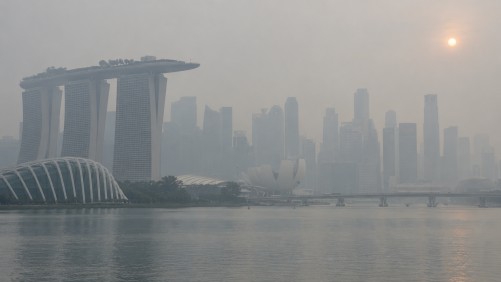
Singapore is grappling with unhealthy air quality levels as haze continues to envelop the island, a situation that has persisted since September. On October 6, the 24-hour Pollutant Standards Index (PSI) readings remained in the unhealthy range, with the central region recording a high of 130, while the north, east, and west registered readings of 107, 112, and 117, respectively. The south was the only region to post a moderate reading of 95. A PSI range of 101 to 200 is classified as unhealthy, indicating significant pollution levels.
The haze has been attributed to smoke from forest fires in Kalimantan and southern Sumatra in Indonesia, where dry conditions have intensified the spread of smoke plumes. This situation is compounded by southeast and east-southeast winds that are blowing the smoke toward Singapore. As a result, fine particle pollution, known as PM2.5, has also seen elevated levels, with readings of 60 in the central region, 59 in the west, and 56 in the east.
Authorities have warned that the PSI could remain in the high-moderate to mid-unhealthy range due to persistent dry conditions in the region. This is exacerbated by weather patterns associated with a strong El Niño, which are expected to delay the onset of the rainy season in Southeast Asia, potentially prolonging the period of poor air quality.
The haze situation in Singapore has worsened since the PSI first entered the unhealthy range last month, with the highest reading of 164 recorded in the central region on September 29. Concerns are mounting that the dry spell could extend longer than usual this year, affecting air quality and public health.